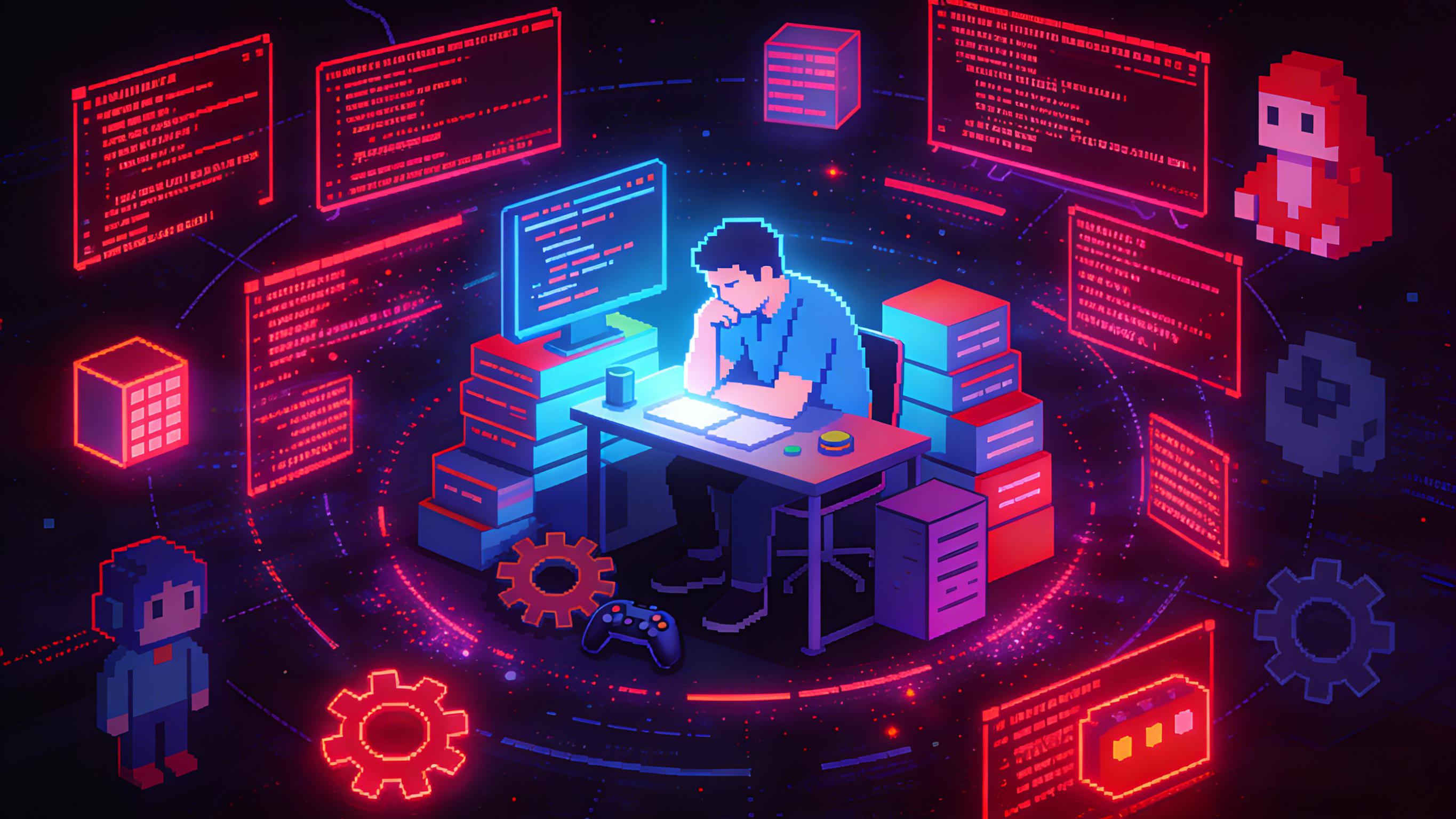
It Happens to Everyone
Before we dive into solutions, let's establish something important: hitting a wall is normal. It's not a sign that you're a bad developer or that you chose the wrong project. It's a universal experience that every game developer — from beginners to veterans — goes through repeatedly.
Even the biggest studios encounter this. Did you know that many celebrated games had major sections or entire spin-offs scrapped during development? Half-Life 2 was famously rebuilt from scratch after a year of work. The Last of Us Part II underwent massive redesigns. Red Dead Redemption 2 had entire mission lines cut. Nintendo has reportedly canceled more game projects than they've released.
If the most experienced teams in the industry regularly hit walls and change direction, you shouldn't feel ashamed when it happens to you.
Recognizing the Warning Signs
Not all obstacles are the same. Understanding what kind of wall you've hit is the first step to deciding what to do about it.
Type 1: The "Not Fun" Wall
You play your game and it just doesn't feel enjoyable. The core loop lacks engagement, the mechanics don't click together, or the experience feels flat. This is the most critical type of wall because it strikes at the heart of your game.
Type 2: The "Too Hard" Wall
You've encountered a technical challenge that seems insurmountable. Maybe it's a complex AI system, networking, or a physics mechanic that's beyond your current skill level. Progress has stalled because you simply don't know how to implement what you need.
Type 3: The "Too Big" Wall
The project has grown far beyond its original scope. Features keep getting added, the content requirements keep expanding, and you can see that finishing will take far longer than you planned — if it ever gets finished at all.
Type 4: The "Burnout" Wall
You're not facing a specific technical or design problem — you're just exhausted. You've lost motivation, enthusiasm, and the energy to open your editor. This is often a combination of the other three types compounding over time.
The Normal Game Development Process
To understand why hitting a wall is normal, it helps to understand how professional game development actually works. The standard process looks like this:
- Concept — an idea is proposed and explored
- Prototype — a rough, playable version is built to test core mechanics
- Playtest — the prototype is tested to see if it's actually fun
- Decision — based on the playtest results, the project moves forward, pivots, or gets canceled
- Production — if approved, full-scale development begins
- Polish — bug fixing, optimization, and final quality pass
- Release — the game ships to players
Here's the key insight: most game projects are killed at the prototype stage. In professional studios, it's common for only 1 in 3 or even 1 in 5 prototypes to make it to full production. The purpose of the prototype phase isn't to guarantee success — it's to fail fast and cheap.
As an indie developer, you should adopt the same mindset. If your prototype reveals that the game isn't working, that's the system functioning correctly. You've just saved yourself months or years of building something that wouldn't have been fun anyway.
When to Shelve Your Project
If you're a new developer and you've hit a wall, here's the honest advice: it's usually better to shelve the project than to force your way through. Here's why:
Low Sunk Cost
If you're a beginner, your sunk cost — the time, money, and emotional energy you've invested — is relatively low. You might feel like you've spent a lot of time, but in the grand scheme of your career, these early projects are learning exercises. The hours you've spent aren't wasted — they've built skills and understanding that will transfer to every future project.
Diminishing Returns
When you're stuck on a project, each additional hour of work produces less and less progress. You spend hours debugging, redesigning, and rethinking without making meaningful forward movement. That same time invested in a fresh project — armed with the lessons you've learned — would produce dramatically better results.
Emotional Toll
Forcing yourself to work on a project you've lost enthusiasm for is draining. It turns game development from something exciting into a chore. This is how developers burn out and quit entirely. It's far better to take a break, start something new, and rediscover the joy of creation.
The Opportunity Cost
Every week you spend stuck on a struggling project is a week you could spend building something else — something that might actually work. New developers often have limited time and energy. Spending it on a project that's clearly not working is a poor investment.
Shelving Is Not Failure
This is perhaps the most important point in this entire article: pausing or canceling a game project is not a failure. It's a decision. And often, it's the right decision.
Think of it this way: a venture capitalist doesn't consider every startup they don't invest in as a failure. They evaluate, make a decision, and move on. Game development should work the same way. You prototype, evaluate, and decide whether to proceed.
Every project you shelve teaches you something:
- What doesn't work — you've eliminated a dead-end approach
- Where your skills need improvement — you've identified knowledge gaps
- How to scope better — you've learned what's realistic for your current abilities
- How to evaluate ideas — you've developed better instincts for what makes a viable project
These lessons are invaluable. They're the difference between a developer who grows and one who repeats the same mistakes.
When to Push Through
Shelving isn't always the answer. There are situations where perseverance is the right call:
- The core is fun, but one feature is broken — if your game's foundation is solid and you're stuck on a specific implementation, consider simplifying or cutting that feature rather than abandoning the whole project
- You're close to a playable prototype — if you're almost at the point where you can test the core loop with real players, push through and get that feedback before making any decisions
- The problem is temporary — if you're facing burnout rather than a fundamental design flaw, a short break (a week or two, not months) might be all you need to return with fresh energy
- You've already invested significant polish — if your game is mostly complete and you're hitting a late-stage wall, it's usually worth pushing through to launch rather than abandoning near-finished work
The key distinction is: are you stuck on a solvable problem, or is the project fundamentally flawed? A solvable problem deserves effort. A fundamental flaw deserves a clean break.
What If You Keep Abandoning Projects?
Shelving one or two projects is healthy. But if you find yourself repeatedly starting and abandoning games — a pattern sometimes called "project hopping" — it's time to look deeper at what's causing it.
Common patterns to watch for:
- Overly innovative mechanics — if your ideas are so original that they're difficult to implement or hard for players to understand, consider starting with more proven game concepts and adding your unique twist gradually
- Scope that's too ambitious — if every project grows beyond what you can realistically complete, you need to develop stricter scoping habits. Cut your next project's scope by 50% and see what happens
- Perfectionism — if you abandon projects because they're not meeting your quality expectations, remember that your first games won't be masterpieces. Done is better than perfect
- Lack of prototyping discipline — if you jump straight into full production without testing your core idea first, you'll keep discovering fundamental problems late in development when they're most expensive to fix
- Skill gaps — if you keep hitting technical walls, invest time in learning before starting your next project. Take courses, follow tutorials, and build small practice projects to level up your skills
The goal isn't to never shelve a project — it's to make sure each shelved project teaches you something that prevents the next one from meeting the same fate.
Shelved Projects Can Come Back
One of the most beautiful things about game development is that no idea is ever truly wasted. A project you shelve today might become your biggest hit tomorrow.
Many successful games started as abandoned ideas that were revisited years later:
- Stardew Valley — Eric Barone worked on the game for over four years, during which he considered quitting multiple times before pushing through
- Hollow Knight — Team Cherry's original concept was much smaller and simpler before evolving through multiple iterations
- Celeste — the full game evolved from a PICO-8 prototype that was made during a game jam
When you shelve a project, save everything — your code, your notes, your design documents, your art assets. Put them in a folder called "Shelved" and move on. Months or years later, when you've grown as a developer and gained new skills and perspective, you might open that folder and see the solution that was invisible to you before.
Developers who revisit old projects are almost always surprised by how much clearer the path forward has become. Problems that seemed impossible now have obvious solutions. Features that felt essential now seem unnecessary. The distance gives you clarity.
A Practical Framework for Decision-Making
When you hit a wall, use this simple framework to decide your next move:
- Identify the wall type — Is it a "not fun," "too hard," "too big," or "burnout" problem?
- Assess your investment — How much time and energy have you put in? Is the sunk cost low enough that walking away is painless?
- Test the core — Can you strip the game down to its simplest version and test whether the fundamental idea works?
- Consider simplification — Can you cut features, reduce scope, or simplify mechanics to make the project viable?
- Make a decision — Push through, pivot, or shelve. Don't stay in limbo — indecision is the biggest time-waster of all
- Document your lessons — Whatever you decide, write down what you learned. This becomes your most valuable resource for future projects
Every game you start but don't finish is not a failure — it's a prototype that taught you what doesn't work. The only true failure is not starting the next one.
Final Thoughts
Hitting a wall in game development isn't a sign of weakness — it's a sign that you're doing something challenging. The developers who succeed aren't the ones who never get stuck. They're the ones who learn to recognize when to push through, when to simplify, and when to walk away.
If you're a new developer staring at a project that feels broken, know this: shelving it is okay. It doesn't mean you failed. It means you're learning. Take the lessons, start something new, and keep building. The skills and instincts you're developing right now — through both successes and abandoned projects — are the foundation of every great game you'll make in the future.
And that shelved project? It'll be waiting for you when you're ready. You might be surprised by what you can do with it next time around.