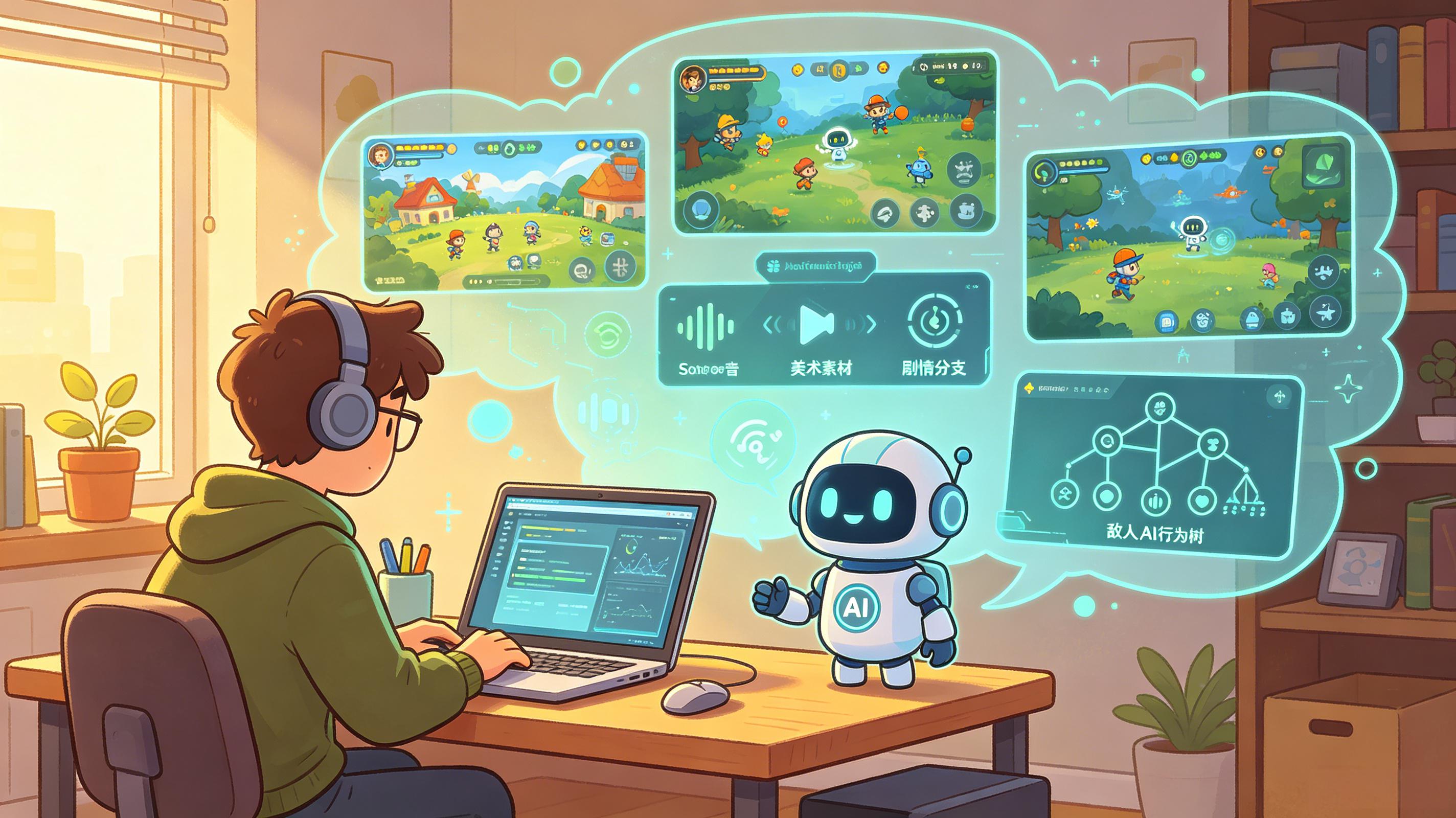
The AI era has arrived, and it's transforming indie game development in ways we couldn't have imagined just a few years ago. While AI is undoubtedly making game development more accessible, one crucial question remains: does AI make it easier for indie games to succeed? The answer might surprise you.
The Reality: Success Remains Elusive
Let's face it: successful indie games have always been the exception, not the rule. Even in the age of AI, this fundamental truth hasn't changed. To succeed, you still need to outperform most other indie games competing for players' attention and wallets. The math hasn't changed—only a small percentage of indie games achieve commercial success.
What AI has changed is how we get there. The landscape has shifted dramatically, creating both opportunities and new challenges for indie developers.
AI's Current Capabilities: Programming, Art, and Design
Current AI tools have reached impressive levels of sophistication, but their strengths are unevenly distributed. Here's how AI performs across different game development domains:
Programming: AI Excels Here
AI has become remarkably capable at writing code. From generating game mechanics to debugging and optimization, AI programming assistants can handle a significant portion of the technical work. For indie developers without formal computer science backgrounds, this is revolutionary—you can now bring complex game mechanics to life without mastering every line of code.
Art and Visuals: AI Is Transforming This Space
The art generation landscape has exploded with tools like MidJourney, DALL-E, Stable Diffusion, and countless others. Concept art, sprites, textures, character designs, and even animations can now be generated in seconds. The quality, while not always production-ready, has improved dramatically. For indie developers who struggle with art, AI is a game-changer.
Game Design and Planning: AI's Weakest Link
Here's where things get interesting—and where the real value of human creativity shines through. While AI can assist with balancing numbers, suggesting mechanics based on existing patterns, and even generating level layouts, it struggles with the fundamental question: what makes a game truly compelling?
AI can analyze what's worked before, identify successful patterns, and generate suggestions based on existing data. But creating something genuinely innovative? Something that breaks conventions and creates a new genre or experience? That's still firmly in the human domain.
Who Benefits Most from AI? Good Game Designers
Here's a counterintuitive truth: AI benefits skilled game designers more than anyone else. If you're a strong game designer with good ideas, AI is incredibly powerful because it amplifies your vision without limiting your creativity.
AI as a Design Accelerator
For talented designers, AI can help with:
- Rapidly prototyping game ideas to test if they're fun
- Generating variations of mechanics to explore design space
- Handling technical implementation so you can focus on design
- Creating art assets to match your creative vision
- Balancing numbers and tuning game feel
A skilled designer can use AI to go from idea to playable prototype in hours instead of weeks. The bottleneck is no longer technical skills—it's creative vision.
The Danger: AI as a False Prophet
Here's a crucial warning: if you ask AI to design a complete game for you, the results will likely be disappointing. Why? Because AI lacks the intuition, cultural awareness, and creative spark that makes games memorable.
Imagine designing a game solely based on what AI recommends. It might create a technically competent game that follows all the "rules" of successful games—but it would be utterly forgettable. The magic that makes players fall in love with a game comes from human experience, emotion, and creative risk-taking.
We've seen some "AI-generated" games gain attention, but almost always because they had an interesting initial concept—a clever hook or unusual premise. The execution often suffers, but the idea was strong enough to capture interest.
The New Paradigm: Ideas Are King
In the AI era, a fundamental shift is occurring: ideas are becoming more valuable than ever before.
Why Ideas Matter More
When anyone can use AI to create technically competent games, what differentiates success from failure? The answer is increasingly the quality of the original idea.
Consider this scenario: two developers both use AI tools to create a game about running a coffee shop. Developer A has a generic concept—make coffee, serve customers, expand the shop. Developer B has a unique twist—the coffee shop is in a magical forest, customers are woodland creatures, and the coffee is brewed from moonflowers that only bloom during eclipses.
With identical AI assistance, Developer B's game will inherently be more interesting because the underlying idea is more compelling. AI can't generate that creative spark—it can only help execute whatever idea you bring to it.
AI as Execution, Not Innovation
The most accurate mental model for AI in game development is this: AI is a powerful execution tool, not a creative generator.
Think of it this way:
- AI can help you build anything you can imagine
- AI cannot tell you what to imagine
- The gap between imagination and execution has shrunk dramatically
- The gap between imagination and imagination remains entirely human
This is why we're seeing games that are "pure AI" occasionally succeed—but only when they started with a genuinely interesting concept. The AI handles the execution, but the human provides the creative spark that makes it worth noticing.
The Changing Skills Landscape
AI is reshaping which skills matter most for indie developers:
Technical Skills: Lowered Barriers
If you couldn't program before, AI has removed much of that barrier. If you couldn't draw, AI art tools have opened new possibilities. The technical floor has risen, but it's now accessible to more people than ever.
Design Skills: Increased Value
Understanding what makes games fun, how to create engaging loops, how to evoke emotions through gameplay—these skills are becoming increasingly valuable. While AI can execute, it still needs human direction.
Creative Vision: The Ultimate Differentiator
The ability to conceive genuinely original ideas, to see opportunities others miss, to understand what players want before they know it themselves—this creative vision is and will remain the ultimate competitive advantage. AI can't teach you this; it can only help you implement it faster.
Practical Implications for Indie Developers
So what does this mean for you as an indie developer? Here's how to navigate this new landscape:
If You're a Strong Designer
Congratulations—you're in the best position to benefit from AI. Your ideas can now be realized with unprecedented efficiency. Focus on:
- Developing your creative vision and unique perspectives
- Using AI to prototype and iterate quickly
- Letting AI handle technical and artistic execution
- Concentrating your efforts on what makes your games distinctive
If You're Still Learning Design
AI provides an incredible opportunity to learn and experiment. You can:
- Create games without waiting to master every technical skill
- Get immediate feedback by testing your ideas
- Study how successful games work by recreating them
- Focus on understanding design principles while AI handles implementation
If You Struggle with Ideas
Be honest with yourself: AI won't help you here. Ideas are still entirely on you. Consider:
- Studying what makes existing successful games work
- Combining existing concepts in new ways
- Finding inspiration in real-world experiences and stories
- Focusing on execution of familiar concepts until your creative muscles grow
The Bottom Line
AI has fundamentally changed indie game development, but it hasn't changed the fundamental rules of success. You still need to create something players want to play. You still need to stand out from the crowd. You still need to execute well.
What has changed is the equation between ideas and execution. In the past, a mediocre idea with excellent execution could succeed. In the AI era, excellent execution is becoming table stakes. The differentiator is increasingly the quality of your ideas.
So embrace AI as the powerful tool it is—but never forget that it's just that: a tool. The vision, the creativity, the understanding of what makes games meaningful—those remain beautifully, irreducibly human. In a world where anyone can make a game, being someone with something to say becomes the most valuable asset of all.
Go make something only you could imagine.