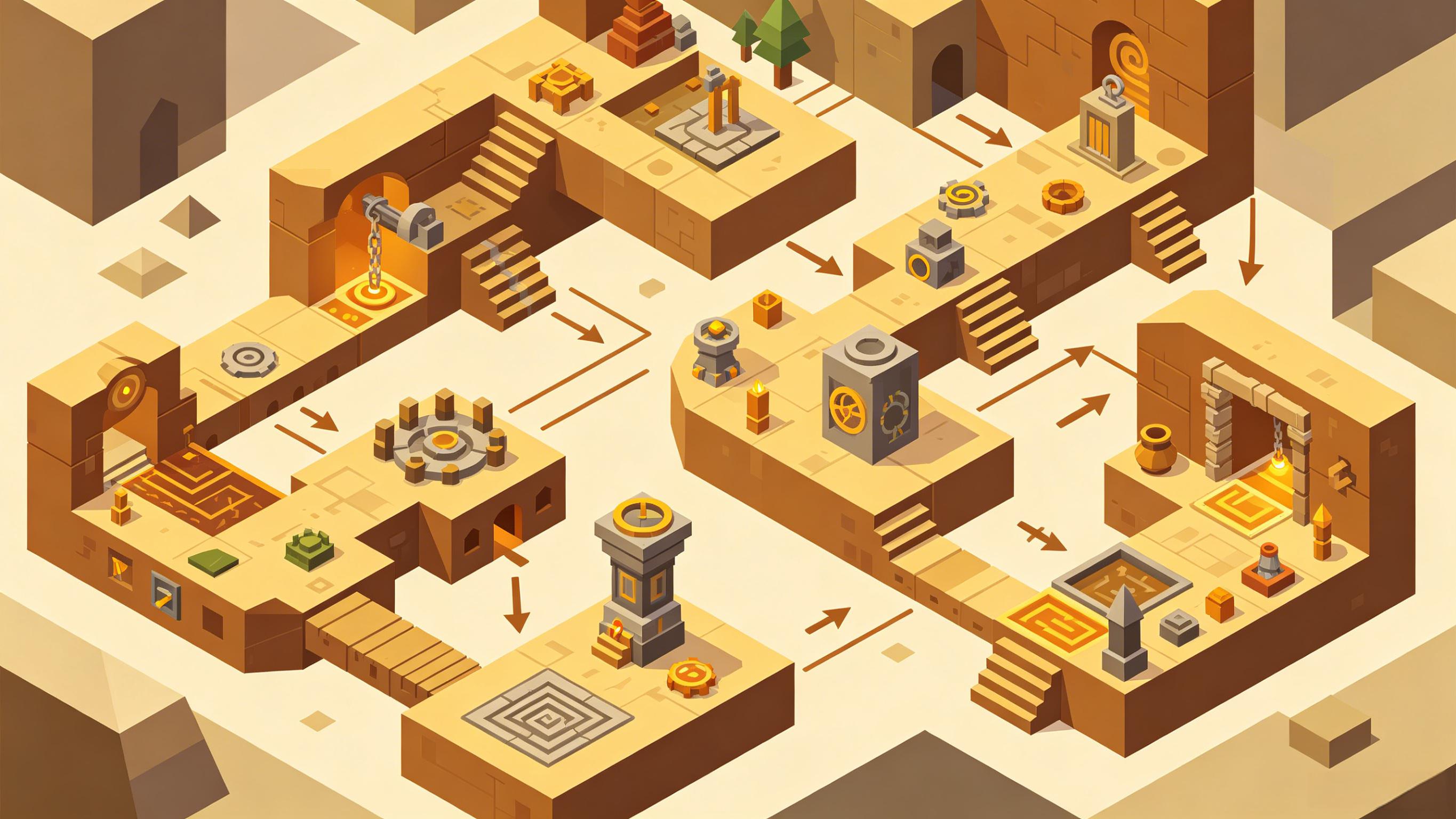
Puzzle games have always been a beloved staple in the gaming world, and for solo indie developers, they might just be the perfect genre to start with—especially the kind of level-based puzzle games exemplified by titles like Animal Well and Leap Year, not the detective mystery style. Here's why you should consider making a puzzle game for your next project.
What Kind of Puzzle Games Are We Talking About?
First, let's clarify: we're not referring to detective mysteries or story-driven whodunits. Instead, we're focusing on level-based, mechanics-driven puzzle games where each level presents a new challenge that builds on the last. Think of games like Animal Well, with its mysterious, interconnected world full of environmental puzzles, or Leap Year, with its clever, bite-sized platforming puzzles that change daily.
Top 7 Reasons Puzzle Games Are Perfect for Indie Developers
1. No Numbers Needed: Skip the Numerical Balancing Act
Unlike RPGs, MOBAs, or even action games, puzzle games don't require complex numerical systems. You won't need a dedicated number-cruncher to balance damage values, loot drop rates, or character stats. Without spending time tweaking spreadsheets, you can focus entirely on the core of your game: the puzzles themselves. This saves you from one of the most tedious and time-consuming parts of game development.
2. Low Art Costs: Simple Is Beautiful
Look at Leap Year: it's built with minimalist, stylized graphics and simple animations, yet it's visually charming and effective. Puzzle games thrive on clarity, not photorealism. Simple geometric shapes, clean color palettes, and straightforward character designs are often all you need. You don't need to hire a team of animators or concept artists—basic art skills (or a small budget for a freelancer) can go a long way. This makes puzzle games one of the most cost-effective genres to develop.
3. Simple Programming: Modular and Manageable
From a technical perspective, puzzle games are a dream for solo programmers. Each level is largely independent—changes to one won't break the entire game. There's no need for complex networking, large AI systems, or intricate save-game mechanics (though a good save system is still important!). The code can be modular and straightforward, making it easier to debug, iterate, and expand. If you're new to programming, puzzle games are a fantastic way to learn and practice without getting overwhelmed.
4. Your Creativity Is the Star of the Show
Puzzle games are one of the best genres for showcasing your unique creative vision. You don't need a huge budget or a team to make something innovative—all you need is one great idea. Maybe it's a new way to manipulate gravity, a clever twist on perspective, or a world that changes based on your actions. The puzzle genre rewards creativity and originality more than almost any other, making it the perfect place to make your mark.
5. Validate Your Game Early with a Single Level
One of the biggest advantages of puzzle games is that you don't have to finish the entire game to know if it's any good. Build one complete, polished level, and you'll have a crystal-clear picture of whether your core concept works. You can test it with friends, share it online, or release a demo—if people love the first level, you can feel confident moving forward. This is a huge contrast to other genres, where you might spend months building systems only to discover the core loop isn't fun.
6. Easy to Scope and Expand
Puzzle games are incredibly flexible when it comes to scope. You can start small—with 10 or 15 levels—and release a complete, satisfying game. If it's successful, you can always add more levels as DLC or a sequel. This makes puzzle games perfect for solo developers who want to ship something quickly without getting bogged down in a multi-year project.
7. Great for Word-of-Mouth and Community
People love sharing their "aha!" moments. When a player solves a clever puzzle, they want to tell their friends about it. This organic word-of-mouth can be incredibly powerful for indie games, helping you build a dedicated community without spending a fortune on marketing. Puzzle games also tend to have long tails—players keep coming back to them, and new players discover them months or even years after release.
Inspiring Examples of Successful Indie Puzzle Games
Let's look at some real-world examples to see what's possible:
Animal Well (Billy Basso)
Created by a single developer over seven years, Animal Well is a masterclass in indie puzzle design. It uses simple, stylized graphics, clever environmental puzzles, and a mysterious atmosphere to create a memorable experience. Its success proves that you don't need a huge team to make a critically acclaimed puzzle game.
Leap Year (Butterscotch Shenanigans)
While technically made by a small team, Leap Year is a perfect example of how simple art and clever puzzles can create a hit. Its daily rotating levels keep players coming back, and its low-key art style keeps the focus on the gameplay.
The Witness (Jonathan Blow)
Okay, so Jonathan Blow had a larger budget, but The Witness still shows the power of a focused puzzle game. It's built entirely around one core mechanic—drawing lines on panels—and expands on it in hundreds of brilliant, surprising ways. It's a testament to how far a single, great idea can take you.
Portal (Valve)
Okay, Valve is a big company, but Portal is worth mentioning because it started as a small student project called Narbacular Drop. Its simple portal mechanic revolutionized puzzle games, proving that a single creative idea can change the industry.
Potential Challenges and How to Overcome Them
Of course, puzzle games aren't without their challenges: coming up with fresh, fun puzzles is hard! But here are some tips to help you out:
- Start with a single mechanic: Pick one simple idea—like pushing blocks, flipping switches, or changing gravity—and explore every possible permutation of it.
- Test early, test often: As soon as you have one level, show it to people. Watch them play, and take notes—you'll learn more from 10 minutes of playtesting than from hours of thinking.
- Iterate, iterate, iterate: Your first version of a puzzle will almost always be too easy or too hard. Keep tweaking it until it feels just right.
- Steal like an artist: Don't copy other games, but study them to understand what makes their puzzles work. What makes a puzzle feel satisfying? How do they teach players new mechanics?
Conclusion: Go Make a Puzzle Game!
For solo indie developers, level-based puzzle games are one of the best choices you can make. They're cheap to develop, simple to program, perfect for showcasing your creativity, and easy to validate early. If you've been thinking about making your first game, why not start with a puzzle game? You don't need a huge budget or a team—all you need is one good idea and the drive to build it.
Remember: your first game doesn't have to be perfect. It just has to be yours. And a puzzle game is a fantastic way to start telling your story. Happy developing!