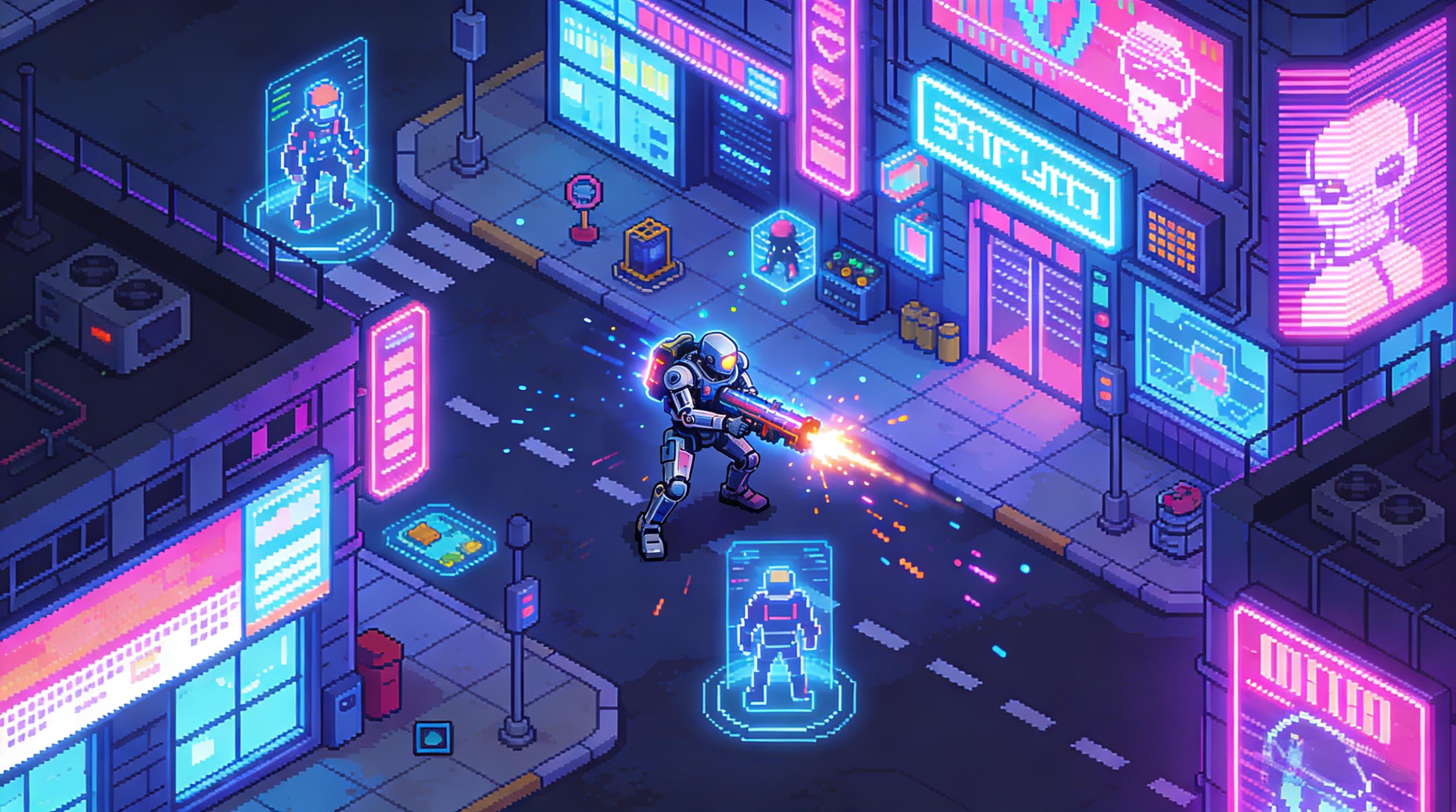
The Roguelike Revolution in Indie Games
Once niche and esoteric, roguelikes have exploded in popularity over the past decade, becoming one of the most dominant genres in indie game development. The term "roguelike" originally referred to games that closely followed the design principles of the 1980 game Rogue — turn-based gameplay, permadeath, procedural generation, and grid-based movement.
Today, the term has broadened to include "roguelite" games that retain core roguelike elements (procedural generation, permadeath, or permanent progression) while incorporating more accessible mechanics. This evolution has made the genre more approachable while retaining its core appeal.
What makes roguelikes so compelling for indie developers? Let's explore the key reasons.
Reason 1: Maximum Replayability with Minimum Content
The greatest strength of roguelikes is their ability to generate endless variety from a relatively small amount of content. This is a game-changer for indie developers working with limited resources.
Consider the alternative: a linear game. For every hour of gameplay, you need to create an hour of unique content — level design, dialogue, enemies, puzzles, and more. This requires enormous amounts of time and resources.
With roguelikes, the equation changes dramatically. By combining procedural generation with player choice, you can create tens or even hundreds of hours of gameplay from a fraction of the content. A single set of enemy types, items, and environments can be rearranged in countless ways, creating a fresh experience every run.
For a solo developer or small team with a 3-6 month development cycle, this efficiency is revolutionary. It's nearly impossible to create a 10+ hour linear game in that timeframe, but a roguelike can easily achieve that — and more.
Reason 2: The Perfect Balance of Randomness and Build Crafting
Modern roguelikes have mastered the art of balancing randomness with player agency. This combination creates a unique gameplay loop that's both unpredictable and satisfying.
- Randomness — Procedural level generation, random item drops, and variable enemy spawns ensure that no two runs are the same. This keeps gameplay fresh and exciting even after dozens of hours.
- Build crafting — Players can strategically combine items, abilities, and upgrades to create powerful synergies. This gives them a sense of control and mastery, even within the randomness.
Games like Balatro exemplify this perfectly. The core mechanic is simply playing poker hands, but the addition of tarot cards, planet cards, and other modifiers creates an almost infinite number of possible builds. Each run feels like a new puzzle to solve.
This balance is what keeps players coming back. They're not just repeating content — they're discovering new combinations and strategies every time they play.
Reason 3: Low Development Cost, High Player Value
From a business perspective, roguelikes offer an exceptional return on investment. Let's break down the numbers:
- Content efficiency — A single enemy type can appear in countless contexts, eliminating the need for dozens of unique enemies.
- Scalable complexity — You can start with a simple core loop and gradually add more content over time through updates.
- Long tail sales — Games with high replayability continue to sell long after launch, as players recommend them to friends.
- Community engagement — Players often share their favorite builds and runs, creating free marketing.
Vampire Survivors is a perfect example. The game was developed by a single person, Luca Galante, with minimal art and sound assets. Yet it has sold millions of copies and keeps players engaged for hundreds of hours.
Compare this to a linear game of similar scope. A 10-hour linear game would require 10 hours of unique content, while a 10-hour roguelike might only require 1-2 hours of base content rearranged in countless ways.
Reason 4: Forgiving Development Process
Roguelikes are inherently forgiving during development. Their modular nature makes them ideal for iterative development — a process indie developers often rely on.
- Easy to prototype — You can test core mechanics with minimal content.
- Scalable content — You can add new items, enemies, or levels incrementally.
- Forgiving of rough edges — Procedural generation means players won't encounter the same flaws repeatedly.
- Natural difficulty progression — Players can choose to play shorter runs while learning the game.
This flexibility is invaluable for indie developers who often need to adapt to changing circumstances, limited resources, or new ideas that emerge during development.
Reason 5: Player Psychology and Engagement
Roguelikes are brilliantly designed to tap into fundamental aspects of player psychology:
- The "just one more run" effect — Runs are typically short (15-30 minutes), making it easy to say "I'll just play one more."
- Progress despite failure — Even failed runs often unlock new content or permanent upgrades, giving players a sense of progression.
- Mastery curve — Players gradually learn the game's systems and improve, creating a satisfying sense of growth.
- Surprise and discovery — The random element means players are constantly discovering new combinations and strategies.
These psychological hooks keep players engaged far longer than most other genres, which is why roguelikes often have some of the highest playtime statistics on platforms like Steam.
Reason 6: The Genre's Natural Evolution
One of the most remarkable things about roguelikes is how they continue to evolve and stay fresh, despite their popularity. The genre has proven incredibly adaptable, with developers finding new ways to innovate within its framework.
- Balatro — Poker + roguelike
- Vampire Survivors — Bullet hell + roguelike
- Hades — Action RPG + roguelike
- Slay the Spire — Deckbuilding + roguelike
- Dead Cells — Metroidvania + roguelike
This adaptability means that even as the genre becomes more popular, there's still plenty of room for innovation. Developers can combine roguelike elements with virtually any other genre, creating unique experiences that stand out from the crowd.
Case Studies: Roguelike Indie Success Stories
Let's examine some of the most successful indie roguelikes and what makes them special:
Balatro
Balatro by LocalThunk is a perfect example of how a simple concept can become a phenomenon. The game takes the familiar mechanics of poker and adds roguelike elements through tarot cards, planet cards, and other modifiers. Its success lies in its accessibility — anyone who understands basic poker can pick it up — and its depth, with countless possible builds and strategies.
Despite its simple art style and minimal sound design, Balatro has sold millions of copies and become a cultural phenomenon, proving that roguelikes can succeed without big budgets or flashy graphics.
Vampire Survivors
Vampire Survivors by Luca Galante (poncle) started as a small passion project with minimal visuals. The core loop — surviving against waves of enemies while collecting power-ups — is brilliantly simple but endlessly addictive.
The game's success demonstrates how roguelikes can turn limited resources into a massive hit. With its low development cost and high replayability, Vampire Survivors has become one of the most profitable indie games of recent years.
Hades
Hades by Supergiant Games represents the higher end of indie roguelikes, with polished visuals, voice acting, and narrative. What makes Hades special is how it integrates its roguelike structure with a compelling story. Each run advances the narrative, creating a sense of progression even as players die repeatedly.
Hades proves that roguelikes can be both commercially successful and critically acclaimed, winning multiple Game of the Year awards.
Dead Cells
Dead Cells by Motion Twin combines roguelike elements with metroidvania exploration. The game features tight controls, beautiful pixel art, and a progression system that encourages players to keep coming back.
Dead Cells demonstrates how roguelikes can appeal to players who might not typically enjoy the genre, by combining it with more familiar gameplay elements.
The "Roguelike Fatigue" Myth
Some critics argue that roguelikes are becoming over-saturated, that players will eventually grow tired of the genre. But the data suggests otherwise.
Steam statistics show that roguelikes continue to be some of the most played games on the platform. New roguelikes like Balatro regularly top the sales charts, and established titles like Hades and Dead Cells maintain active player bases years after their release.
The reason for this enduring popularity is simple: roguelikes offer something that no other genre can — endless variety and constant discovery. Even as more roguelikes are released, each one offers a unique combination of mechanics, themes, and progression systems.
Players don't get tired of roguelikes any more than they get tired of puzzle games or action games. They get tired of poorly designed games. A well-crafted roguelike with interesting mechanics and meaningful progression will always find an audience.
Is a Roguelike Right for Your Indie Project?
While roguelikes offer many advantages, they're not the right choice for every indie project. Consider these factors:
- Core loop strength — Roguelikes live or die by their core gameplay loop. If your core mechanic isn't fun to repeat, a roguelike structure won't save it.
- Content variety — Even with procedural generation, you need enough unique content to keep runs feeling fresh.
- Progression system — Players need a sense of advancement between runs to stay motivated.
- Target audience — Some players simply don't enjoy permadeath or the randomness of roguelikes.
That said, for many indie developers — especially solo developers or small teams — roguelikes offer an unbeatable combination of efficiency, player engagement, and commercial potential.
Designing a Successful Indie Roguelike
If you're considering making a roguelike, here are some key principles to keep in mind:
1. Focus on a Strong Core Loop
The most important element of any roguelike is its core gameplay loop. This is the basic cycle of actions players will repeat hundreds or thousands of times. It needs to be simple, satisfying, and have enough depth to remain interesting over time.
2. Balance Randomness and Agency
Too much randomness can make players feel powerless, while too little can make runs feel repetitive. The best roguelikes strike a balance, giving players meaningful choices while still surprising them.
3. Create Meaningful Progression
Players need a reason to keep playing even after failing. This could be unlocking new characters, items, or abilities, or advancing a narrative.
4. Start Small and Iterate
Begin with a minimal viable product and gradually add content. This allows you to test your core mechanics early and make adjustments based on player feedback.
5. Embrace the Genre's Flexibility
Don't feel constrained by traditional roguelike design. The most successful modern roguelikes are those that innovate and combine elements from other genres.
The Future of Roguelikes in Indie Games
The roguelike genre shows no signs of slowing down. If anything, it's becoming more diverse and ambitious.
We're seeing roguelikes that incorporate:
- Co-op multiplayer — Allowing friends to tackle runs together
- Persistent worlds — Combining roguelike elements with open-world exploration
- Narrative depth — Using procedural generation to create unique story experiences
- Cross-genre hybrids — Blending roguelike mechanics with everything from rhythm games to management sims
As indie developers continue to push the boundaries of the genre, we can expect even more innovative and engaging roguelikes in the future.
Roguelikes aren't just a genre — they're a design philosophy that aligns perfectly with the constraints and goals of indie game development. By leveraging procedural generation, player choice, and iterative design, indie developers can create games that offer hundreds of hours of gameplay from a fraction of the content required by linear games.
Final Thoughts
The rise of roguelikes in indie game development isn't a coincidence. It's the result of a perfect alignment between the genre's strengths and the realities of independent game creation.
For indie developers working with limited time, money, and resources, roguelikes offer an unprecedented efficiency. They allow small teams (or even solo developers) to create games that compete with much larger projects in terms of playtime, engagement, and commercial success.
But beyond the practical advantages, roguelikes also offer something more profound: they celebrate the joy of discovery, the thrill of overcoming challenges, and the satisfaction of mastery. These are universal gaming pleasures that transcend budget and production values.
As we look to the future of indie games, it's clear that roguelikes will continue to be a dominant force. They're not just a trend — they're a fundamental design approach that empowers indie developers to create experiences that are both ambitious and achievable.
So if you're an indie developer looking to maximize your impact with limited resources, consider the roguelike. It just might be the perfect genre for your next project.